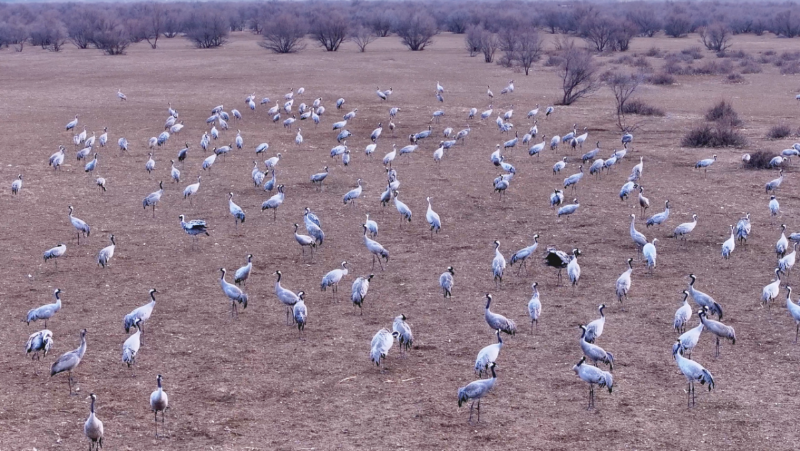
这批数字代表迁徙进程,不是实时保证
保护区通报的是阶段监测:东方白鹳10余只、灰鹤100余只、白琵鹭600余只,另有4000余只绿翅鸭、1600余只反嘴鹬、900余只黑尾塍鹬及白额雁等。不同类群在秋季分批到达,水位、风和补给条件会让鸟群迅速移动。
这些数量不能相加成游客一天必见清单,也不能据此推断具体鸟仍停在原处。个人记录要写明日期、时段、观察范围和估算方法,避免把保护区总量冒充单点计数。
远距离怎样区分鹳、鹤与琵鹭
东方白鹳体型大,白色身体配黑色飞羽,嘴长而深色;灰鹤整体灰,颈腿修长,飞行时颈部伸直;白琵鹭通体偏白,扁平匙状嘴是关键,但逆光远距离下不应只凭体色判断。
反嘴鹬黑白分明、嘴明显上翘,常在浅水横扫取食。热浪抖动、雾和长距离会放大误判;看不清嘴形、翼色或飞姿时,记录到科、属或未定比猜测更可靠。
低水位湖滩的观察边界
使用堤岸、固定观景台和管理方明确开放的线路,以单筒望远镜代替向鸟群前进。退水后的泥滩可能表面干硬、下层陷软,也可能被沟汊切断;不要驾车、徒步或乘非许可船只追随鸟群。
不公开夜栖地、珍稀鸟稳定河段或实时坐标。若鸟群持续抬头、停止取食、集体远离或惊飞,应立即后退;临时封闭、巡护提示和防火要求优先于任何行程。
The numbers show migration progress, not a live guarantee
The reserve reported a monitoring snapshot: more than ten Oriental Storks, over 100 Common Cranes, more than 600 Eurasian Spoonbills, over 4,000 Eurasian Teal, over 1,600 Pied Avocets, over 900 Black-tailed Godwits and Greater White-fronted Geese. Different groups arrive in waves, and water, wind and feeding conditions can move them quickly.
Do not turn the totals into a guaranteed day list or assume the birds remain at one point. A personal record should include date, time, coverage and counting method, never presenting a reserve-wide total as a single-site count.
Separating storks, cranes and spoonbills at distance
Oriental Stork is very large and white-bodied with black flight feathers and a long dark bill. Common Crane is mainly grey with long neck and legs, holding the neck straight in flight. Eurasian Spoonbill is largely white with a flattened spoon-shaped bill, but colour alone is insufficient in backlight.
Pied Avocet is boldly black and white with a strongly upturned bill and often sweeps it through shallow water. Heat haze, fog and distance magnify error; if bill shape, wing pattern or flight posture is unclear, leave the record at family, genus or unidentified level.
Boundaries on low-water mudflats
Use embankments, fixed viewpoints and routes explicitly opened by management. A spotting scope is safer than moving toward a flock. Exposed flats may look firm while remaining deep and soft, and channels can cut off a return; never drive, walk or take an unauthorized boat after birds.
Do not publish roosts, dependable rare-bird reaches or live coordinates. Retreat when a flock repeatedly raises heads, stops feeding, moves away or flushes. Temporary closures, ranger instructions and fire rules override every itinerary.